AI Automation Services
AI automation systems that respond, follow up, and report.
Millionify builds practical AI automations for companies that want faster lead response, cleaner CRM handoff, smarter reporting, internal AI assistants, and workflows their teams will actually use.
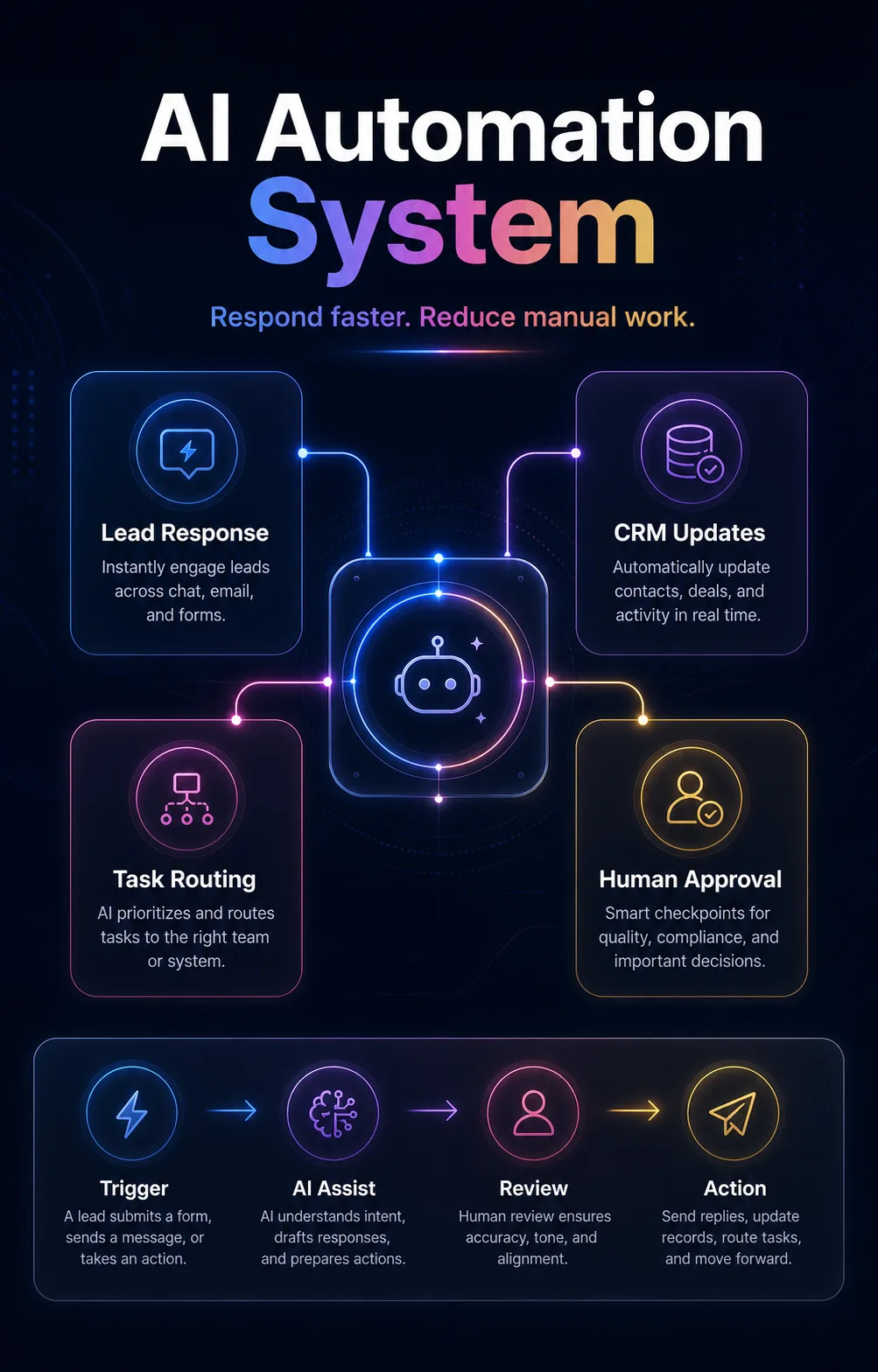
AIworkflow implementation
24/7repetitive task support
Humanapproval where it matters
(01)AI implementation
AI only matters when it changes the work your team does every day.
Most companies do not need another AI demo. They need real workflows where leads are handled faster, admin work gets reduced, reports become useful, and humans stay in control of sensitive decisions.
Want AI that actually moves revenue and operations?
Book a strategy call and we will map your repetitive workflows, current tools, lead-handling gaps, and the first automation worth building.
(02)Automation solutions
Build the AI layer around the business you already run.
We connect AI to the places where work already happens: CRM, forms, calendars, inboxes, WhatsApp, support tools, documents, dashboards, spreadsheets, Zapier, Make, n8n, APIs, and your team’s daily routines.
Common builds include AI automation audits, first workflow sprints, AI-assisted sales follow-up, internal knowledge assistants, support triage, automated reports, content operations, and integration layers between your existing tools.
Website, ad, chat, call, WhatsApp, and form leads can be routed, tagged, assigned, followed up, and reported without waiting for manual checks.
AI-assisted reminders, reactivation flows, quote follow-ups, stale-deal nudges, and booking prompts keep serious prospects moving.
AI can summarize conversations, draft replies, answer internal questions, prepare sales context, and surface next actions for humans to approve.
Dashboards, weekly summaries, alerts, and owner-level recommendations make performance easier to manage without manual spreadsheet work.
Human-in-the-loop checkpoints, access rules, testing, fallback paths, logs, documentation, and rollback plans keep automation controlled.
(03)Revenue workflows
From slow handoffs to supervised AI follow-up.
AI automation can make the first few minutes after a lead arrives much stronger: source capture, assignment, response draft, booking path, task creation, manager visibility, and CRM update.
Instant lead handling
Forms, calls, chats, WhatsApp, ads, and landing pages can trigger routing, tagging, reminders, and follow-up steps.
AI-assisted sales work
AI can summarize context, draft replies, prepare call notes, recommend next steps, and update CRM fields for review.
Manager visibility
Response speed, owner activity, stuck leads, bad-fit patterns, and missed opportunities become visible sooner.
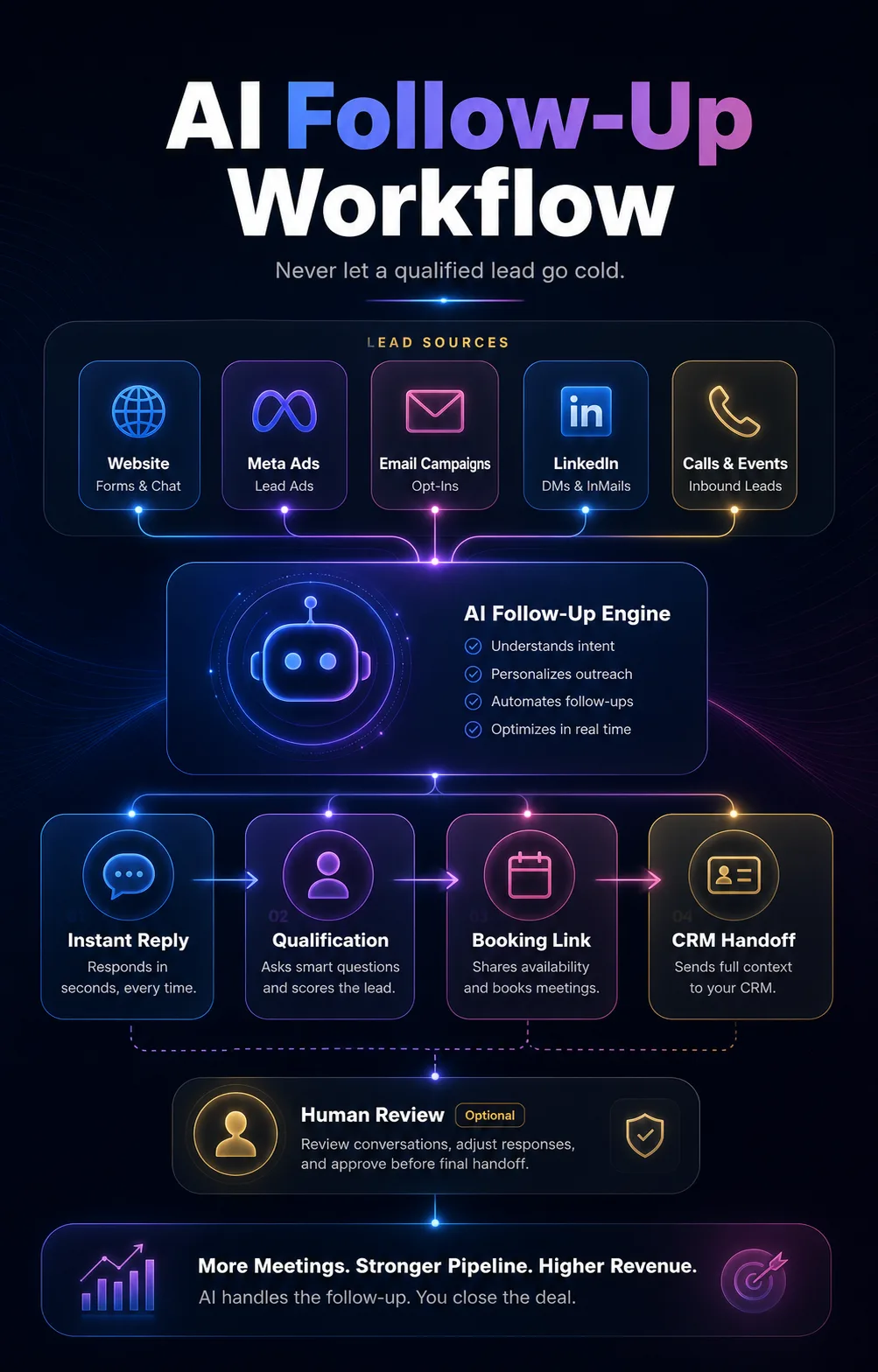
AI follow-up engineLead capture, routing, drafts, tasks, bookings, and handoff.
(04)How we work
How we turn AI from a tool experiment into a working business system.
We start with business workflows, not model hype. The goal is to identify where AI can save time, improve response, reduce missed handoffs, and create measurable operating leverage.
Automation opportunity audit
We map repetitive tasks, missed handoffs, slow follow-up, manual reporting, disconnected tools, and AI use cases with real business value.
Workflow and AI safety blueprint
We define triggers, inputs, data boundaries, human approvals, escalation rules, model/prompt behavior, success metrics, and fallback paths.
Tool and integration plan
We decide what should connect across CRM, email, WhatsApp, forms, calendars, ads, support tools, documents, dashboards, Zapier, Make, n8n, or APIs.
Build the first useful workflows
We ship practical automations first: lead routing, follow-up tasks, AI drafts, summaries, booking flows, alerts, reporting, or support triage.
Test with edge cases and real users
We test bad inputs, duplicate leads, wrong owners, incomplete data, sensitive actions, approval queues, missed triggers, and handoff quality.
Launch, train, and improve
We document the system, train your team, monitor early behavior, improve prompts and routing, and add the next workflows only after the first ones work.
The first AI workflow should be useful enough to survive real usage.
We would rather ship one controlled workflow your team trusts than a pile of disconnected automations nobody uses.
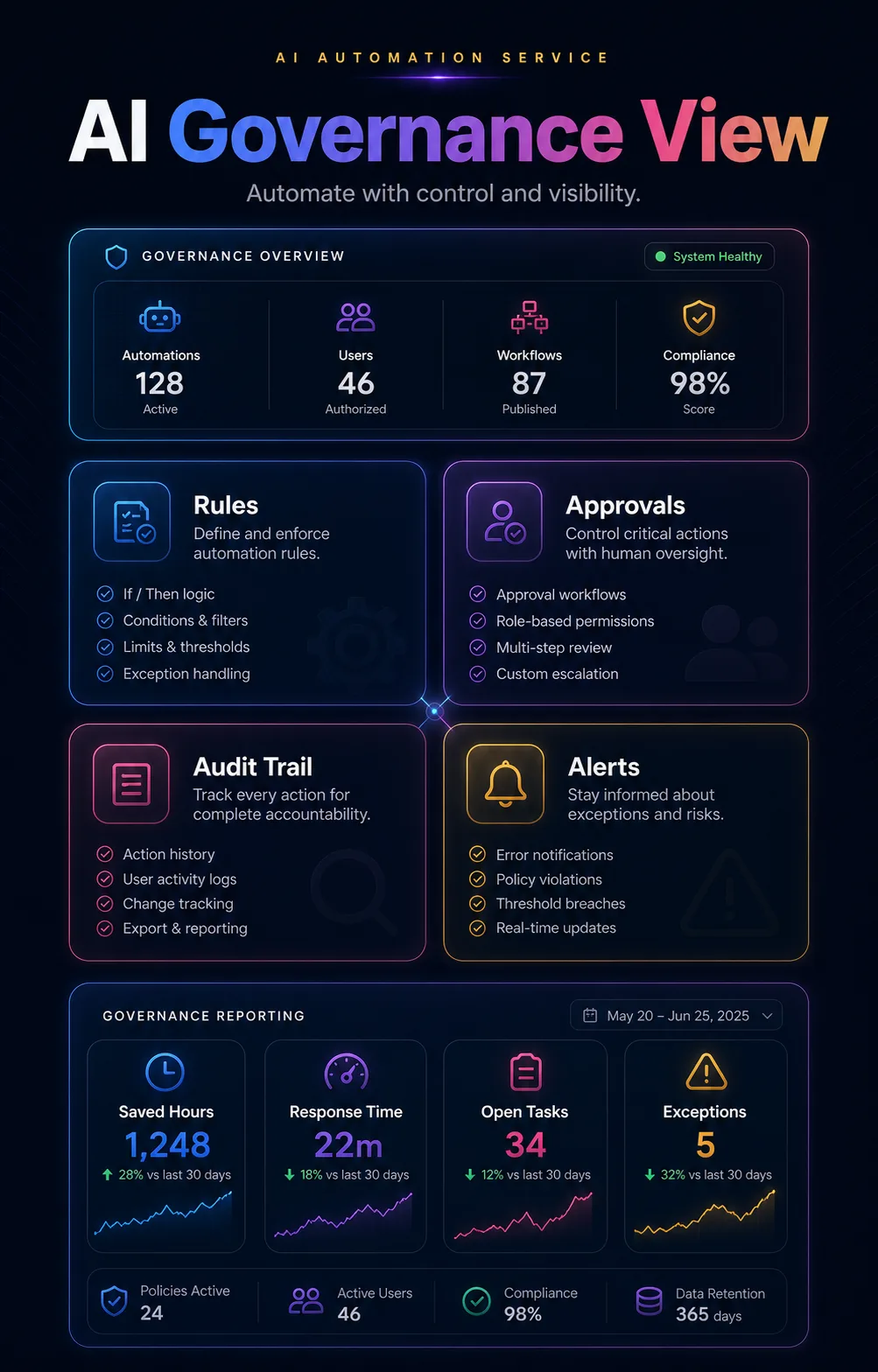
Controlled AI layerApprovals, permissions, logs, reporting, and escalation.
(05)Safety and adoption
AI should make the team faster without making the business reckless.
Good AI automation has boundaries. We decide where AI can act, where it can draft, where humans approve, and how the team can inspect what happened.
Human in the loop
AI can draft messages, summarize records, and recommend actions while humans approve high-impact decisions.
Traceable behavior
Logs, testing, fallbacks, and documented SOPs make automations easier to inspect, fix, and improve.
Team adoption
Training, simple workflows, clear ownership, and practical dashboards help AI become part of daily work.
(06)Engagement modes
Start with the right level of AI implementation.
Some companies need an AI automation audit. Some need a first workflow built. Others need an ongoing AI operating layer that connects marketing, sales, support, and operations.
AI Audit
Automation roadmap- Workflow, tool, data, and repetitive-task audit
- Highest-value AI use cases ranked by effort, risk, and impact
- First workflow sprint recommendation
- Metrics, safeguards, and launch-readiness checklist
Sprint
First automation build- One high-value workflow designed end to end
- CRM, forms, email, WhatsApp, calendar, dashboard, or integration setup
- AI prompts, routing logic, approvals, and human handoff
- Testing, documentation, training, and launch monitoring
AI OS
Ongoing automation layer- Automation roadmap, backlog, governance, and monthly prioritization
- Multiple connected workflows across sales, support, reporting, and operations
- Prompt tuning, system monitoring, workflow repair, and new use cases
- Monthly automation performance view and next-action plan
Not sure where AI can actually help your business first?
Book a strategy call and we will review your workflows, tools, lead path, reporting, support load, and implementation risks before recommending the next step.
(07)Measurement
Track whether AI is creating leverage, not just activity.
AI automation should be judged by business outcomes: faster response, fewer manual steps, better handoffs, cleaner reporting, fewer repeated questions, and more opportunities followed up.
Speed and coverage
Lead response time, follow-up completion, missed inquiry recovery, ticket triage, and task creation.
Hours saved
Manual reporting, repetitive replies, admin updates, research, summaries, and content operations reduced.
Quality checks
Human approvals, failed triggers, bad data, edge cases, escalation rate, and audit trail review.
Next workflows
Prioritized recommendations for the next AI automation based on impact, risk, adoption, and effort.
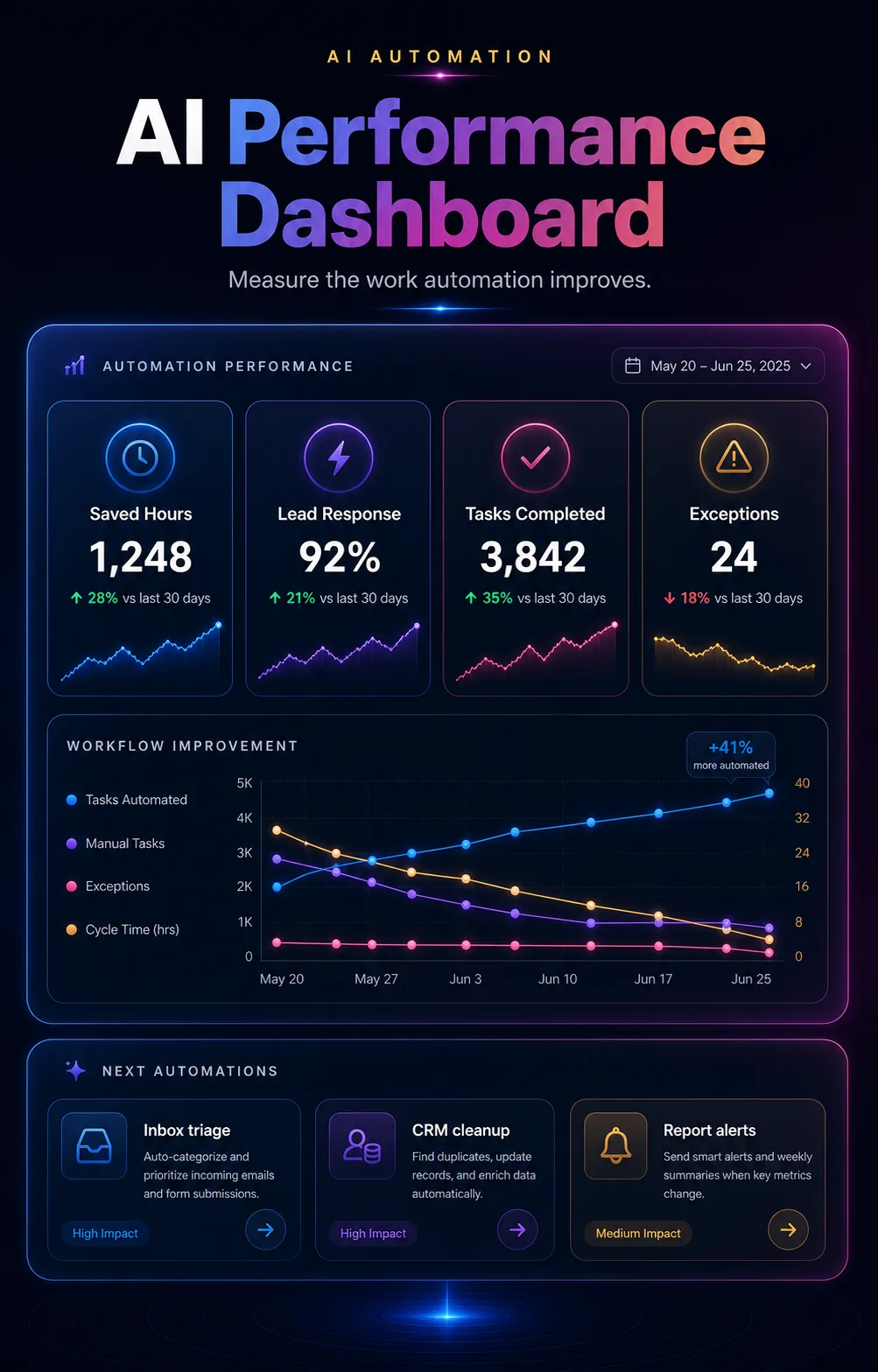
AI performance viewResponse, savings, approvals, exceptions, and next workflows.
(07)What people say
Client proof
Real clients. Real testimonials.
 ★★★★★
★★★★★
Millionify helped from strategy through launch, delivered the funnel professionally, and handled every change with care.
 ★★★★★
★★★★★
Communication was easy and consistent, the attention to detail was strong, and the final quality exceeded expectations.
 ★★★★★
★★★★★
Fast, responsive, accurate, and deeply knowledgeable. Millionify became the go-to team for funnel work.
 ★★★★★
★★★★★
Knowledgeable, communicative, and willing to go above and beyond to get the project right.
 ★★★★★
★★★★★
The work led to a meaningful increase in traffic and leads after the engagement.
 ★★★★★
★★★★★
Reliable, fast, honest, and straightforward to work with.
 ★★★★★
★★★★★
Millionify made sure every required piece was in place to complete the project successfully.
 ★★★★★
★★★★★
Helpful, patient, communicative, and genuinely invested in the outcome of the work.
(09)Questions
AI automation questions (F.A.Q.).
We can build AI-assisted lead routing, CRM follow-up, missed-call or missed-lead workflows, AI reply drafts, sales summaries, reporting dashboards, internal knowledge assistants, content operations, support triage, WhatsApp/email/SMS handoffs, and integrations across the tools your business already uses.
No. The strongest AI systems remove repetitive work, prepare information, draft messages, flag issues, and create next steps while humans approve sensitive or relationship-heavy actions.
Usually yes. We plan around your existing stack first: HubSpot, Salesforce, GoHighLevel, Zoho, Pipedrive, email, WhatsApp, calendars, forms, spreadsheets, helpdesks, Zapier, Make, n8n, Airtable, and dashboards. We recommend replacement only when the current stack blocks the business goal.
For most growth-focused businesses, the best first workflow is lead handling: source capture, owner assignment, instant response, booking path, follow-up task, CRM update, and manager visibility. It is measurable and directly tied to revenue.
We use human-in-the-loop approvals, permissions, data boundaries, logs, test cases, fallback rules, and documented SOPs. AI should not be allowed to take high-risk action without the right controls.
We define practical metrics such as response time, leads followed up, meetings booked, hours saved, tickets triaged, report time reduced, stalled opportunities recovered, and manual steps removed.
Ready to turn AI into a working business system?
Tell us which workflows are repetitive, where leads or tasks get stuck, and which tools your team already uses. We will map the first practical AI automation path.